Travel Guide
Mussoorie Travel Guide: Beyond Mall Road
Leave Mall Road behind and discover Mussoorie through Landour’s forest roads, old churches, waterfalls, mountain food and quiet Himalayan viewpoints.
Opening note
The first Mussoorie scene should not be Mall Road at seven in the evening. It should be six in the morning. A blue shop shutter rises halfway. A kettle begins to whistle behind it. Two dogs stretch beside a silent railing, and a man in a woollen cap sweeps last night’s deodar needles from the road. Beyond the railing, the Doon Valley has disappeared beneath an ocean of white cloud. A few minutes later, the first school vehicle growls uphill. A church bell sounds somewhere inside the mist. The smell of butter, tea and wet earth travels out of a small kitchen window. This is the Mussoorie people often miss. Mall Road is bright, crowded and undeniably part of the town. But Mussoorie becomes more intimate when the market ends—along Camel’s Back Road before sunrise, inside Landour’s cedar shadows, beside an old church or on a forest trail where the only moving thing is the mist. This Mussoorie travel guide goes beyond Mall Road to find the town’s quieter stories, hidden walks, local flavours and landscapes that stay in memory long after the holiday ends.
Orientation
Know the place
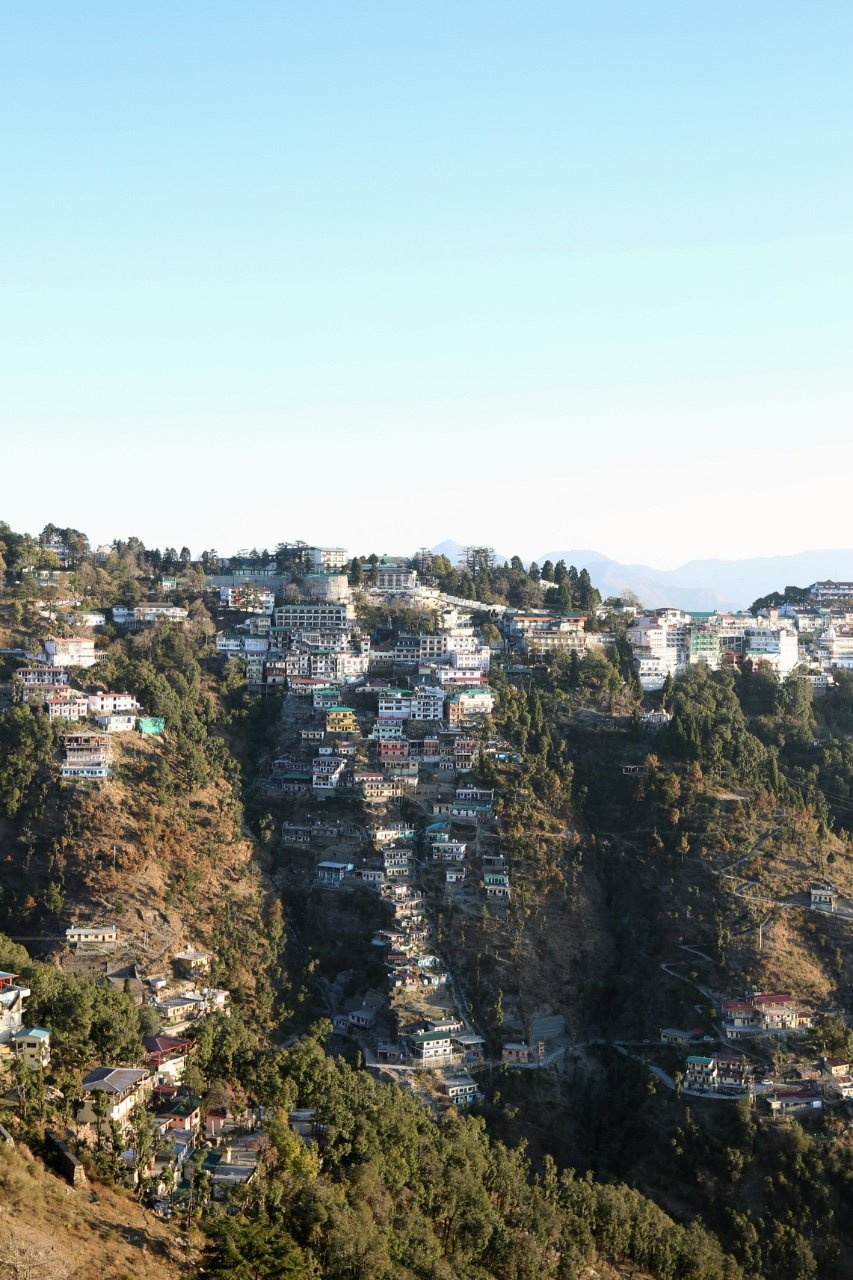
Mussoorie rests in the Garhwal foothills of Uttarakhand, roughly 2,000 metres above sea level. The town looks north-east towards the higher Himalayan ranges and south across the broad Doon Valley. The Dehradun district administration places Mussoorie approximately 38 kilometres from Dehradun. The hill town began developing during the nineteenth century and remains closely connected with neighbouring Landour, an older cantonment settlement wrapped around one of the highest ridges in the area. Popular Mussoorie stretches between Library Bazaar and Picture Palace, with Mall Road connecting much of the central town. But beyond that familiar line are forested neighbourhoods, colonial-era buildings, Tibetan culture, walking trails, waterfalls and viewpoints where the loudest sound may be wind moving through deodar branches.
02 · Why it matters
More than a point on the map
Mussoorie has two faces.
The first glows beneath shop signs. It sells woollen caps, photographs, coffee and warm corn rubbed with lemon. Families stroll beneath strings of lights while the valley sparkles far below.
The second face wakes much earlier. It lives on a footpath behind Landour, where moss softens an old stone wall. It appears when clouds enter an open window without permission. It waits beside a bench on Camel’s Back Road and watches the town disappear beneath rain.
The magic of Mussoorie is the movement between these two worlds. One moment, you are surrounded by voices and shopfronts. Ten minutes later, you turn into a narrow lane and hear only your own footsteps, a mountain stream and the brief flutter of a bird moving between trees. Mussoorie does not need Mall Road to be rejected. It only needs the rest of the town to be noticed.
Experiences
What stays with you
Walk through Landour before breakfast : Reach Landour while the shops are still opening. The road curves between deodar trees, old cottages and stone walls darkened by years of rain. A baker pulls the first tray from an oven. Tea glasses collect steam. Somewhere beyond the trees, the Himalayas wait for the clouds to move. Walk through Char Dukan, Sisters Bazaar and the surrounding cantonment roads. Visit St. Paul’s Church and observe the old houses without treating them as photography sets. Landour is not a single attraction. The walk itself is the reason to come.
Watch the Himalayas from Lal Tibba : Lal Tibba is one of Mussoorie’s highest viewpoints and looks towards the distant snow-covered Himalayan ranges. Visit early in the morning before traffic and crowds gather. On a clear day, the peaks appear slowly—first as pale outlines, then as white ridges floating above the darker hills. Visibility is never guaranteed. Sometimes the clouds remain, and the waiting becomes part of the morning.
Walk along Camel’s Back Road : At dawn, Camel’s Back Road feels far removed from central Mussoorie. The path follows the curve of the ridge. On one side, old hillside homes sit among trees. On the other, the valley drops into blue distance. Walk slowly. Listen to the town waking behind you—the first horn, a distant whistle and the rhythmic footsteps of morning walkers. Return around sunset for a completely different scene, when the Doon Valley begins collecting lights.
Visit George Everest Estate : George Everest’s House stands above open grasslands and broad valley views. Built in 1832, the estate overlooks the Doon Valley on one side and the Aglar River valley on the other. Arrive early, before the approach becomes busy. Walk beyond the restored buildings and watch clouds cast enormous moving shadows across the hills. The weather can change rapidly, so carry a warm layer even when the morning begins in sunlight. Enter the forests around Cloud’s End : Cloud’s End feels like an appropriate name when the road narrows and the forest begins closing around it. Deodar and oak trees rise on both sides. Fallen needles soften the ground, and birds move through branches high above the trail.Combine the area with a guided visit towards Benog Wildlife Sanctuary. The Ministry of Tourism recommends using a guide on forest trails to better understand the local landscape and wildlife. Official Mussoorie nature itinerary. Do not leave marked trails or enter restricted forest areas.
Discover Happy Valley : Happy Valley carries a different part of Mussoorie’s story. Prayer flags move above walls, monks walk between buildings, and the Shedup Choepelling Temple overlooks the surrounding hills. The area reflects the Tibetan community that became part of Mussoorie’s cultural landscape. Visit respectfully, keep your voice low and confirm photography rules before taking pictures inside religious spaces.
Find the quieter waterfalls : Kempty Falls is famous, accessible and often extremely crowded. Visit early if it is part of your plan, before the road and viewing areas become busy. For a quieter atmosphere, explore places such as Jharipani Falls, Bhatta Falls or Mossy Fall—but only after confirming current access and trail conditions. After rain, the forest smells of wet leaves and stone. Water appears between trees before the waterfall itself becomes visible. The sound grows louder with every bend. Wear shoes with grip and never climb across wet rocks for photographs.
Visit Gun Hill before the rush : Gun Hill is one of Mussoorie’s highest viewpoints and can be reached by cable car or a steep walking route. The summit becomes busy later in the day. Visit early for a better chance of clear views and a quieter experience.
On a cloudless morning, the landscape opens in every direction—Mussoorie’s ridge below, the Doon Valley fading south and the higher Himalayas standing pale in the distance. Official Gun Hill information
Let Mall Road have one evening : Going beyond Mall Road does not mean pretending it has no charm. Walk there after sunset. Steam rises from food stalls. Children lean over railings to watch the valley lights. Couples carry paper cups of coffee, shopkeepers call from warm doorways and old songs drift from somewhere you cannot locate. Mall Road becomes meaningful when it is one scene in the journey—not the whole film.
04 · Plan
Plan smart, travel easy
How to reach
By road
Follow the reviewed route shown above. Distances and travel time are guidance rather than live traffic information.
By train
Dehradun Railway Station is the nearest major railway station, approximately 36 kilometres away. Buses and taxis for Mussoorie are available around the railway station and other city transport points.
By air
Jolly Grant Airport near Dehradun is the nearest airport.
From the airport, travellers must continue by road through Dehradun. Keep additional time for city traffic and the final mountain climb.
Best time to visit
March to June
Spring begins with clearer mornings, flowering hillsides and comfortable walking weather.
By May and June, Mussoorie becomes a lively summer escape. Mall Road fills with families, taxis form long lines and popular attractions grow crowded.
Visit on weekdays and begin sightseeing early.
July to September
During the monsoon, Mussoorie becomes almost unreal.
Clouds cross roads like slow-moving rivers. Moss glows on walls. Rain taps on tin roofs, and sometimes the valley vanishes for an entire afternoon.
This is Mussoorie at its most cinematic—but also its most unpredictable. Landslides, slippery trails, falling stones and road delays are possible.
October to November
Autumn brings sharper visibility, golden evening light and cooler nights.
This is one of the best periods for views of the higher Himalayas. It is also a good season to witness Mussoorie’s winterline—a striking band of colour that appears above the horizon around sunset under suitable conditions.
The Ministry of Tourism recognises the winterline as one of Mussoorie’s distinctive seasonal experiences.
December to February
Winter mornings can be beautifully clear, while frost gathers on shaded paths and smoke rises from kitchen chimneys.
Snowfall is possible but never guaranteed. Do not plan a trip solely around seeing snow.
Pahad Calling recommendation: Choose March or April for gentle spring weather, October or November for clearer views, and the monsoon only if you genuinely love rain and can keep your plans flexible.
People & place
Food and local culture
Mussoorie’s food reflects the many communities that have shaped the town. Garhwali dishes, Tibetan kitchens, old bakeries, North Indian comfort food and hill-station café culture exist within a few winding roads. Garhwali flavours Look for traditional dishes such as: Kafuli, Phaanu, Chainsoo, Aloo ke gutke, Mandua roti, Jhangora ki kheer. These dishes may be easier to find at homestays or restaurants consciously serving regional food.
Tibetan food: Momos, thukpa and noodles are part of Mussoorie’s everyday food landscape, especially around Tibetan communities and market areas. On a cold evening, a bowl of thukpa arrives with steam clouding the window. Outside, people pull their jackets tighter while the valley disappears into darkness.
Landour and Mussoorie bakeries. The town has a long baking tradition. Fresh bread, rusks, cinnamon rolls, cakes, biscuits and preserves appear in bakeries across Mussoorie and Landour.
Before you leave
Plan with care
Useful notes
- Stay for at least two or three nights.
- Visit on weekdays if possible.
- Begin Landour, Lal Tibba and George Everest early.
- Walk wherever distances and health permit.
- Confirm parking before booking accommodation.
- Carry a compact umbrella and waterproof jacket during the monsoon.
- Wear shoes with grip on forest and waterfall trails.
- Keep warm layers throughout the year.
- Carry some cash for small shops and taxis.
- Download offline maps before exploring quieter roads.
- Ask before photographing residents, schools or religious spaces.
- Use a local guide for forest trails.
- Keep plans flexible when clouds or rain affect visibility.
- Carry your waste back from viewpoints and trails.
- Spend one morning without a sightseeing checklist.
Things to avoid
- Avoid arriving on peak-season weekends without confirmed parking.
- Do not stop vehicles on narrow bends for photographs.
- Avoid forest trails during thunderstorms or heavy rain.
- Never climb onto wet rocks near waterfalls.
- Do not cross barriers at viewpoints or cliff edges.
- Avoid feeding or approaching monkeys.
- Keep food inside your bag around forested areas.
- Do not expect guaranteed snowfall or Himalayan views.
- Avoid loud music in Landour, forests and residential areas.
- Do not photograph cantonment or restricted areas.
- Never leave food packaging, bottles or cigarette waste on trails.
- Avoid trying to cover every attraction in a single day.
07 · Make it yours
Suggested itinerary
- Day 1 – The town and its first evening : Arrive in Mussoorie and settle into your accommodation.Walk along Camel’s Back Road in the late afternoon. Watch the light change over the valley before entering Mall Road for dinner. Let Mall Road be your introduction, not your entire journey.
- Day 2 – Landour in slow motion : Reach Landour early. Walk through Char Dukan, Sisters Bazaar and the surrounding forest roads. Visit St. Paul’s Church and continue towards Lal Tibba. Spend the afternoon in Happy Valley or return to a quiet café with no plan beyond watching the weather move.
- Day 3 – George Everest and the western forests : Visit George Everest Estate early in the morning. Continue towards Cloud’s End or take a guided nature walk around the Benog landscape. Return before dark and stop at a quiet viewpoint for sunset. Families wanting to visit Kempty Falls should replace the forest walk with an early-morning waterfall visit rather than squeezing everything into one day.
A final note
Mall Road is Mussoorie’s bright front window. But the town’s real stories wait along the roads that leave it. They wait where rainwater runs beside an old stone wall, where a church bell disappears into fog and where the forest briefly opens to reveal the white Himalayas before closing again. Mussoorie is not at its most beautiful when everything is visible. Sometimes it is most alive when a cloud hides the road ahead, and you keep walking simply to discover what appears next. Come for the familiar hill station. Then leave the familiar road behind.
No approved comments yet. Be the first to share your thoughts.